
Sometimes we need to think about what the purpose of schools history actually is.
We need to ask ourselves what is the point of history as a schools subject? And more specifically what is the point of history in a mid 21st century curriculum?
These are difficult questions and could be the focus of a whole different article.
One of the great attributes that history holds, compared to other subjects is this: at its best it teaches students to be critical thinkers. It allows them to challenge constructions of knowledge.
After all this is what historical interpretations are all about. Here students should be taught to understand how and why historical interpretations are constructed and how they differ.
We are presently still living in a world where policy makers are committed to a knowledge-rich approach. This is all well and good but, unfortunately knowledge rich has been misunderstood.
In this world disciplinary knowledge and critical thinking have played second fiddle to substantive knowledge and its retrieval.
Challenging Constructs
But if history deserves its place in a mid 21st century curriculum it needs to be used to show students how to challenge and critique constructs. The disciplinary nature of the subject needs to be given more status.
After all, they are living in a world where information is everywhere. And this information is no longer tested for accuracy, instead it used to create a compelling narrative. Sometimes, it is used as a weapon of misinformation.
If we are going to survive in an online world that bombards us with compelling yet inaccurate narratives, surely we need to equip young people with the skills they need to question, critique and challenge these narratives?
Questioning and testing these narratives for accuracy is a crucial skill needed to be an educated citizen in a 21st century democracy.
Simply learning facts and writing history essays to pass an exam isn’t enough.
So, what practical steps can the history teacher take to begin to help pupils critique and challenge narratives and knowledge constructions?
Beat the expert
In a typical lesson sequence we often use a textbook extract or clip to provide new knowledge to pupils.
In this model they glean their knowledge from watching the video or reading the narrative. And then we often get them to do something with this knowledge.
Yet it is a good idea to actually give them new knowledge and use it to critique the video clip / textbook account / webpage.
So, instead or, or as well as using the clip or the book to give them knowledge, get them to critique it.
What might this look like in the classroom?
Example 1: Challenge the Historian
This is classic example can be used in any context that you can find a juicy quote about. Here it used at the beginning of a Norman Conquest Enquiry.
Show them to start of the Conquest episode from Simon Schama’s classic series: A History of Britain.
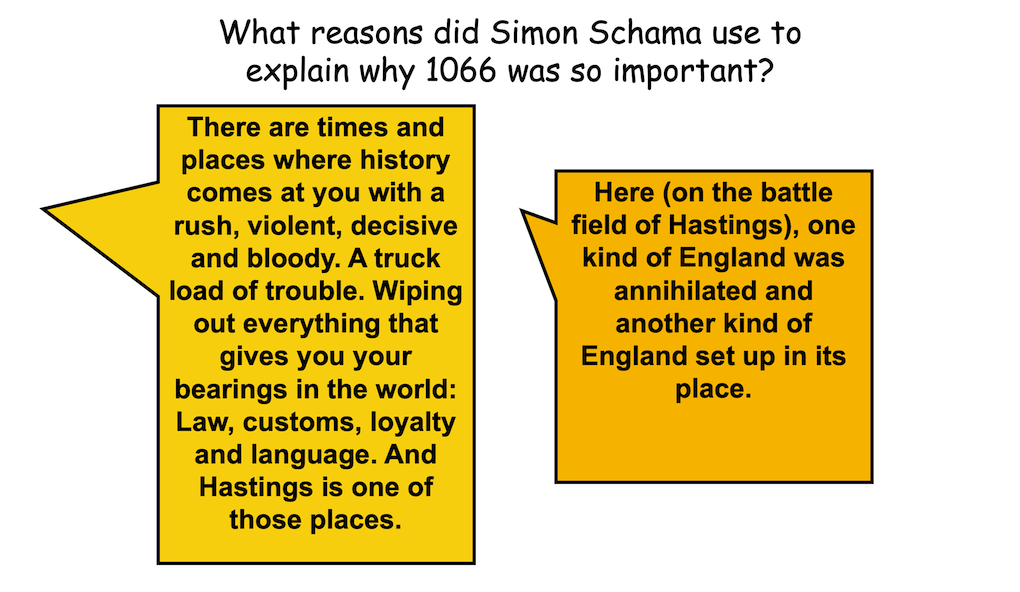
Emphasise his words and then use them as as a way to investigate whether he was right or not? Then, after exploring different areas of the Norman Conquest in your lesson sequence, return to Schama and evaluate whether or not he was right.
Here is another Norman Conquest example.
Example 2: Challenge the documentary
Instead of answering yet another exam question on Stresemann, critique a clip. This makes for a meaningful end product.
First teach them how Stresemann can be seen as the saviour of Weimar and how he might have papered over the cracks.
Having armed them with clear knowledge of Weimar 24-29, ask them what they would expect to see in a short video about Stresemann.
Agree a list of essential knowledge that should be covered.
Then watch this clip and evaluate how much of the agreed list is included, what is missed out and what other info not in the agreed list was featured.
Discuss reasons why the video included certain knowledge. And why somethings might have been ommitted?
Then get them to write a comment / review of the clip on YouTube – or in their books, insist they are write critically.
Example 3: Challenge the textbook
This example is great. Again arm them with knowledge about a particular topic.
Then use this knowledge to critique a textbook account or diagram.
This image comes from a previous blog.
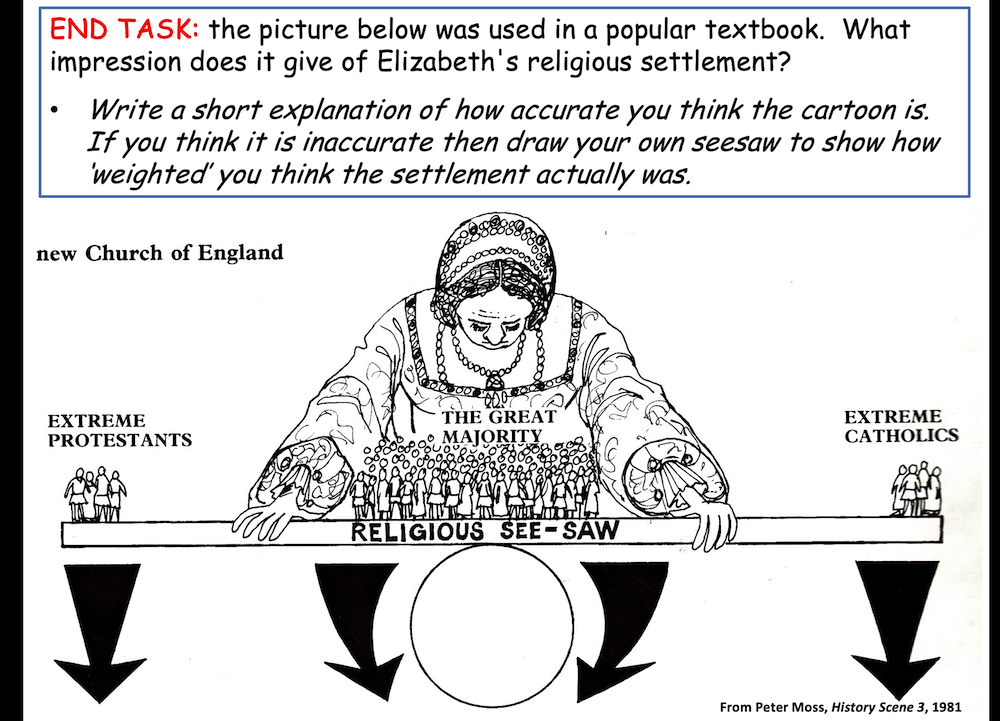
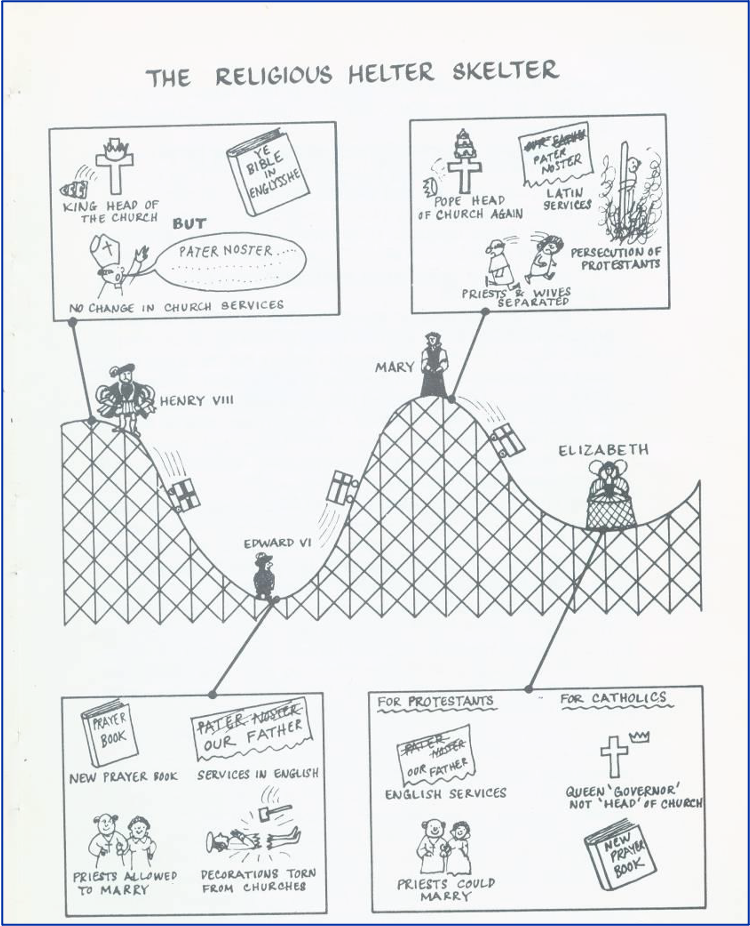
You could use the same idea to challenge this classic image of the Tudor Rollercoaster.
Pull out what is wrong with the image, by using their new found knowledge. They could critique the time span of each monarch, the depth of each change in comparison with other monarchs, or the knowledge included in the boxes.
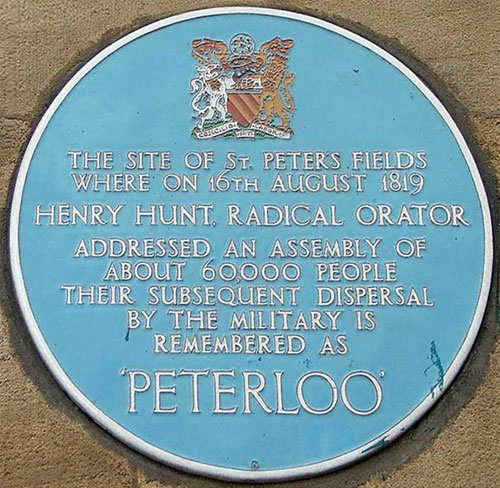
You can do the same with plaques.
Here is an old plaque from 1972 commemorating ‘Peterloo’. Once armed with knowledge they can critique the wording and consider why it was worded in this way.
There is a lesson on HRC which does this for you.
Or you could use any textbook account or webpage or post.
Ultimately, in this age of misinformation, it’s really important that we get students to challenge narratives.
With the increasing growth of AI, it is going to get more and more difficult to spot fakery. So, lets start now.